
Results
-
£37.95
Rondo from Horn Concerto No.3 - Wolfgang Amadeus Mozart
Estimated dispatch 5-14 working days
-
£39.95
Good Old Songs No.3 - Edrich Siebert
Estimated dispatch 5-14 working days
-
 £54.99
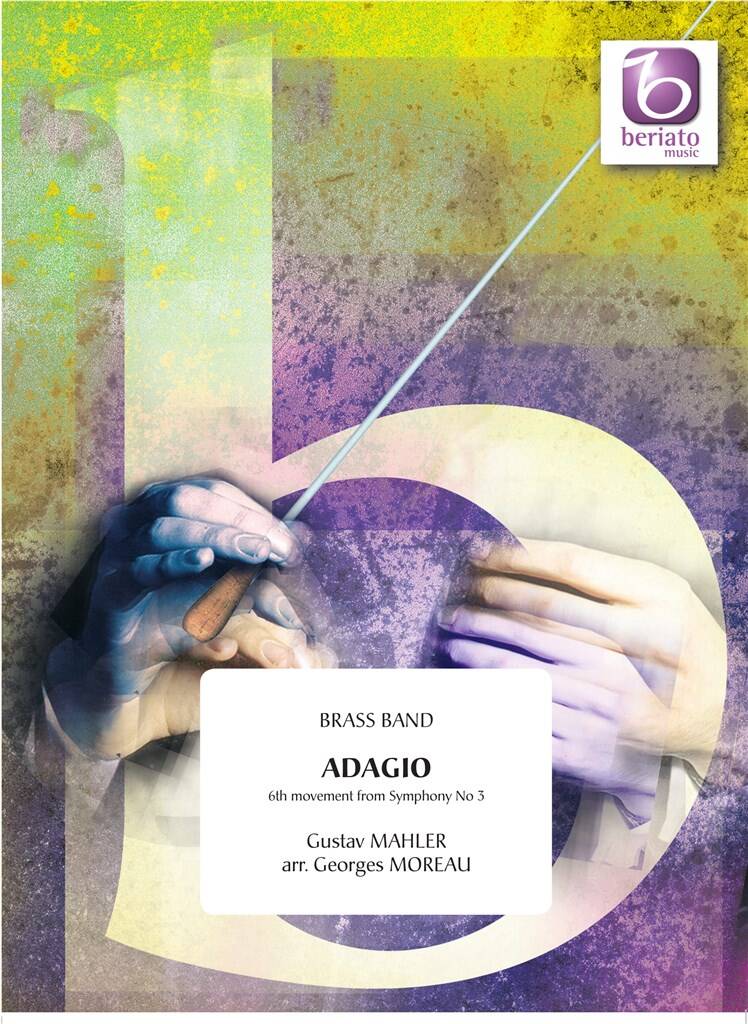
Adagio From Symphony No. 3 - Gustav Mahler - Georges Moreau
Gustav Mahler is probably one of the most important composers of late Romanticism. His symphonies are emotional extravaganzas of hectic, near neurotic movements on the one hand and extremely beautiful melodies and wonderful choral music on the other hand. This Adagio from his 3th symphony, which has been arranged in a majestic way by Georges Moreau, is a perfect example.
Estimated dispatch 5-14 working days
-
 £115.00
Iron Man 3 - Brian Tyler - Bertrand Moren
Estimated dispatch 5-14 working days
-
 £124.20
Blessed Bones (3 Trombones) - Marcel Saurer
Estimated dispatch 5-14 working days
-
£107.80
Arctic Funk (Introduction no. 3) - Torstein Aagaard-Nilsen
After composing "Introduction" in 1989 and "Entrada" in 1990, Aagaard-Nilsen received a new commission for a "concert-opener", this time from Tromso Brass in 1991.Tromso is a city in the north of Norway, but despite the cold and snowywinters, the city is famous for it's night-life.In "Arctic Funk" you might get a feeling of a part that take place between ice-rocks and snow-wrapped mountains.
Estimated dispatch 5-14 working days
-
 £45.00
Andromeda - Dan Price
Following the popularity of Dan's concert opener Starburst , this sequel provides yet another exciting addition to the concert repertoire, equally at home as a finale or as a concert opener. The work is dedicated to Samantha Harrison and Elland Youth Band, who gave the premiere performance as part of their 2019 European Youth Brass Band programme in Montreaux, Switzerland. Listen: Duration: 00:04:00 Grade: 3/3.5
Estimated dispatch 5-7 working days
-
 £25.00
March - The Traditional
The Traditional is a concert march that takes influence from the great band marches of William Rimmer and T.J. Powell. Composed in 2004 and runner-up in 'the mouthpiece.com march competition'. Duration : 00:03:30 Grade : 3 / 3.5
Estimated dispatch 5-7 working days
-
 £25.00
She's a Lassie From Lancashire
She's a Lassie from Lancashire is a British musical hall song from the pen of writing partnership C.W. Murphy, Dan Lipton and John Neat. The song gained widespread popularity through performances and recordings by the revered Florrie Forde. Commissioned by Mark Peacock for the Longridge Band , this reflective setting by Dan Price evokes the rolling Lancashire countryside, with subtle hints of industrialisation, mill machinery and the echoes of the song's musical hall origins. Duration: 00:03:50 Grade: 3/3.5
Estimated dispatch 5-7 working days
-
 £37.35
A Fugal Overture (Brass Band) Gustav Holst arr. Rob Bushnell
A Fugal Overture was written in 1922 by Gustav Holst. It was first performed at the Royal Opera House, Covent Garden on 14 May 1923 and was used as an opening work to Holst's one-act opera The Perfect Fool. It received its concert premiere on 11 October 1923 at one of Henry Wood's Queen's Hall Promenade Concerts. It is an early example of neoclassicism and was influenced by the counterpoint of J. S. Bach, despite its unconventional use of the fugal process. Holst began writing the piece in the summer of 1922, having hoped to develop it into a ballet. It is divided into three sections, the fugal subject with its distinct 3+3+2 pattern, a slower section with solos at the end, and a third section where the subject returns. Although reviews of the piece were mixed at the time of its premiere, the likes of Adrian Boult have said it was "an invigorating work that could effectively start any [...] concert". In more recent years, it has been compared to John Adam's A Short Ride in a Fast Machine. This arrangement is for the British-style brass band, with alternative parts for horns in F and bass-clef lower brass. A recording of the original composition can be found here: www.youtube.com/watch?v=a8xfwJyFq2E. Duration: Approx. 5.40 minutes Difficulty Level: 1st Section + PDF download includes parts and score. Sheet music available from www.brassband.co.uk Instrumentation: Soprano Cornet Eb Solo Cornet Bb Repiano Cornet Bb 2nd Cornet Bb 3rd Cornet Bb Flugel Horn Bb Solo Horn Eb 1st Horn Eb 2nd Horn Eb 1st Baritone Bb 2nd Baritone Bb 1st Trombone Bb 2nd Trombone Bb Bass Trombone Euphonium Bb Bass Eb Bass BbTimpani Percussion 1-2
In Stock: Estimated dispatch 1-3 working days
 View Music
 Listen to MP3